Introduction
The real opportunity is not AI enthusiasm. It is workflow judgment.
Two years of AI hype, and your Tuesday still looks like last Tuesday. This book is not here to change that with more tools. It is here to help you change a few things. Carefully, in the right order.
You probably picked up this book because something just is not adding up.
For two years now, everyone has been telling you that AI will give you your time back. You hear about it at conferences. Vendors send you pitch decks loaded with jargon like "agentic orchestration" and "autonomous transformation." Even your neighbor's nephew is showing off what a chatbot can do on his phone.
But meanwhile, your actual workday looks exactly the same. You are still begging clients for signatures. Still manually updating proposals. Still sending meeting reminders. Still tearing your hair out looking for a file that was sent last Tuesday, which now lives in three separate places but is somehow impossible to find.
If that sounds familiar, welcome.
The real problem is not a lack of enthusiasm
When small service businesses come to me frustrated with AI, the issue is almost never the AI itself. The tools are genuinely incredible: they can draft, summarize, extract, and sort data at a level that would have felt like science fiction just a few years ago.
The real issue is the system that sits around the tool.
Take a four-person consultancy. Across their team, they were spending well over a day a week just on proposals and follow-ups. The principal partner keeps a yellow legal pad right beside her laptop. The same three to-do items have been sitting on it since Monday. At this point, the pad is less of a planning tool and more of an art installation.
They tried using an AI assistant to write their proposals, and it worked beautifully. The text sounded better, and the drafts were finished faster. But they immediately got stuck in the exact same fog: nobody actually knew which proposals had been sent out, who was supposed to follow up, when to do it, or which version of the price list to use. The bottleneck was never the writing. Speeding up the writing phase just produced more proposals waiting politely in the wrong place.
If you pour AI into a confused workflow, you do not clear the fog. You just light it up.
We see this everywhere. A small clinic automated their appointment reminders, but nobody was monitoring the inbox when patients replied. A law firm wired up an AI tool to summarize incoming documents, only to realize their documents arrive through five different channels and the AI was only looking at one.
Three different businesses. Three different industries. The exact same problem. The AI worked flawlessly; the system around it was broken.
There is a short rule for this, and it serves as the spine of this book: do not automate confusion.
What this actually looks like
Picture a partner at a consultancy. Let us call her Anna. It is Friday at 6:40 p.m. The office is empty. That yellow legal pad on her desk still has Monday's three unmarked items on it. She has not gone home yet because she promised a client a proposal on Wednesday, and the last clean version of it is buried somewhere in an email thread she cannot find.
By the end of this book, Anna's Friday is going to look very different. She will still have clients, tight deadlines, and a printer with its own emotional weather. But she will not be rebuilding her work from memory every single week.
The real opportunity for your business right now is not AI enthusiasm. It is workflow judgment: deciding which repeated, tedious tasks genuinely deserve a system, and then building a system you can actually trust.
What this book is, and what it is not
Think of this book as a diagnosis-first guide to building genuinely useful, AI-supported workflows for your small service business. I wrote it specifically for owners and operators who are smart, incredibly busy, and decisively non-technical.
I will never ask you to figure out what an API is, learn to code, or rebrand your consultancy as a "tech platform" just because someone on LinkedIn got excited. What I will ask you to do is take an honest look at how work actually moves through your week.
The book is built around a 90-day plan. Three phases:
- Scan (Days 1-15). Look at a normal working week and find where the hours actually go. Not where you think they go. Where they go. Then choose the one or two workflows repeated often enough, defined clearly enough, and safe enough to be worth improving first. Most of the value in an AI project is decided here, before a single tool is opened.
- Sprint (Days 16-60). Build one workflow at a time, in small, testable pieces. Decide where the AI helps and where a human must stay in the loop. Write down what "good" looks like so you can tell whether the workflow is working.
- Sustain (Days 61-90). Once the workflow is live, keep it useful. Assign an owner. Review it on a cadence. Notice when reality drifts from what the workflow assumes. This is the part almost everyone forgets, and the part that decides whether your investment compounds or quietly rots.
The no-hostage principle
A good workflow is one you can switch off without the whole place going dark. We are not building systems that trap you. We are building systems your business actually owns, that a sensible successor could follow, and that run safely even on a slow Tuesday.
You already have most of what you need
Let us settle one thing right away: you almost certainly do not need to buy more apps.
When I walk into a typical small service firm, I usually find a calendar, a shared inbox, some kind of CRM, an accounting tool, a document drive, and two or three other systems that someone introduced years ago and everyone now just tolerates. There is usually at least one AI assistant being used quietly by a couple of people on the team. And almost always, there are a few paid software subscriptions that nobody can quite remember signing up for. They sit there like gym memberships for software: paid monthly, rarely used, and fiercely defended with the phrase, "We might need it soon."
Your bottleneck is rarely a lack of tools. The real gap is how work moves between the people, the data, and the systems you already have. That is what we are going to fix.
When AI actually helps a small service business, it thrives in the seams. It drafts the message that needs to go out. It pulls data out of the messy document that just arrived. It sorts the request that just landed. It summarizes the meeting that just ended. Small, specific, reviewable jobs. Exactly the kind of work this book is going to teach you to do well.
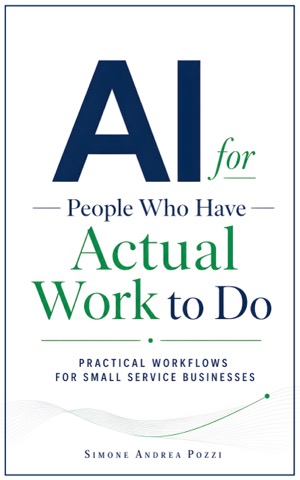
AI for People Who Have Actual Work to Do
The full guide walks you through the complete 90-day Scan, Sprint, Sustain method: naming the right workflows, building them safely, keeping humans in the loop, and making your investment compound instead of quietly disappear.
Get the full guideAvailable on Amazon Kindle, Apple Books & Google Play