FINANCE
How to Read Crypto Charts
Without being manipulated
Open any crypto community online and within seconds you'll find a price target. "Bitcoin is going to $200k by year-end." "This altcoin is about to break out." Someone will have drawn lines on a chart, given them names, and announced what the market is about to do.
The problem isn't the charts. Charts are just price history — they're neutral data. The problem is the method: almost all popular crypto chart reading is prediction in disguise. It looks rigorous because it has jargon and lines and indicators. But at its core, it's still a guess about the future dressed up in technical clothing.
There's a calmer alternative. Instead of trying to forecast where a market is going, you read what state it is in right now. This distinction — between classification and prediction — changes what you pay attention to and how you make decisions.
Nothing in this article is financial advice. This is a plain-English explanation of one approach to reading charts — what the method is, why it exists, and how it works.
Why crypto predictions keep failing
It's worth understanding the structural reasons prediction is so unreliable in crypto specifically — not just in any market.
Extreme volatility. Crypto prices move faster and further than almost any other asset class. A move that would take a stock years to make can happen in a week. That scale of volatility overwhelms most predictive models — the signal disappears inside the noise.
No underlying cash flows to anchor valuations. When you value a company's stock, you can at least try to estimate future earnings. Most cryptocurrencies have no equivalent anchor. There's no dividend, no revenue, no asset base to return to when prices overshoot. This makes valuation-based prediction nearly impossible.
Heavy susceptibility to manipulation. Crypto markets are less regulated than traditional markets, and many coins have relatively small float — meaning a single large holder can move prices significantly. Coordinated pump-and-dump activity is not rare. If someone with enough capital can shift a price, chart patterns can be manufactured on purpose.
Reflexivity. This is the strangest one. In traditional markets, analysis is supposed to reflect reality. In crypto, belief becomes reality — temporarily. If enough people believe a price will reach a certain level, buying pressure can push it there. Then, when the belief fades, it reverses. The chart pattern was real, but its cause was the prediction itself, not any underlying change in value. This makes prediction circular in a way that's difficult to untangle.
These aren't reasons to avoid crypto entirely. They're reasons to be honest about what chart reading can and can't do — and to be suspicious of anyone who claims confident foresight.
The alternative: reading the state, not the future
Imagine a weather station on the side of a mountain. The thermometer twitches: up a tenth, down two-tenths, back up again. If you want to know whether it's warmer today than yesterday, the twitching number is useless — you need to average it. But averages lag. A cold front that arrives at 3pm won't show in the hourly average until 3:30. You cannot have both precision and stability. The choice is which one to trust, and for which purpose.
A classification approach makes the same trade. Instead of asking "where will this price go?", it asks: what direction is this market moving in right now, according to a smoothed view of recent history?
One way to do this uses four smoothed moving averages — lines that follow price but with different degrees of smoothing, so faster ones respond quickly and slower ones give a broader picture. The relationship between these lines describes a state:
- Bullish — price action is trending upward across multiple timeframes
- Bearish — trending downward
- Neutral-Bullish — mixed signals, with an upward lean
- Neutral-Bearish — mixed signals, with a downward lean
A flip is when the state changes — for example, from Bearish to Neutral-Bullish. Flips are meaningful moments. No flip means the state is holding; the current condition persists.
This is not a prediction. It doesn't say the price will rise or fall. It says: based on recent price history, here is the current character of this market's movement. That's a more honest claim, and it's one you can verify in real time.
What chop looks like — and why it matters
Not every market is in a clean state. Sometimes prices move sideways: up a bit, down a bit, no net progress. In a classification system, this shows up as frequent flips with little price change between them.
This is called chop. A practical rule of thumb: if a coin has flipped state more than three times in 60 days without making meaningful net progress, it's chopping. The system is generating signals, but the signals aren't pointing anywhere useful.
The correct response to chop is to do nothing and wait for clarity.
This sounds obvious, but it's actually where many people lose money. Every flip in a chopping market looks like it might be the real one — the start of a new trend. People follow the signal, the price reverses, they follow again. The market goes nowhere but the trading costs add up, and the emotional toll compounds.
Identifying chop and choosing to wait is a skill, not a failure of nerve. The absence of a clear state is itself information: this market isn't ready.
Reading the wider market, not just one coin
Individual coins can be noisy even when the broader market has a clear direction. One way to get a higher-level picture is to look at confluence — what percentage of the top 100 coins are in each state at any given time.
If more than 60% of the top 100 coins are in a Bullish state, that's broad market participation. Money is moving across the market, not concentrated in a few names. Historically, broad participation tends to be more sustainable than narrow leadership.
If fewer than 30% of coins are Bullish, even if a few high-profile coins are making headlines, the underlying market health is thin. That context matters before acting on any individual coin's state.
Confluence doesn't tell you what will happen. It tells you how widespread the current conditions are — and that's a meaningful input to any decision about whether to act or wait.
A free tool to try this
If you use TradingView, there is a free Pine Script indicator that applies this four-state classification to any coin's daily chart. It's available at github.com/vitopod/four-state-pine — open source, no cost, no signup required.
A note on settings: there are two presets, STS (Standard Trend System) and OTS (Optimised). Use STS. The optimised version performs better in historical backtests because it was tuned against past data, but that tuning doesn't generalise as well to live markets. The standard preset has a smaller gap between historical and live performance — which is the more honest measure of whether something actually works.
Want the full guide?
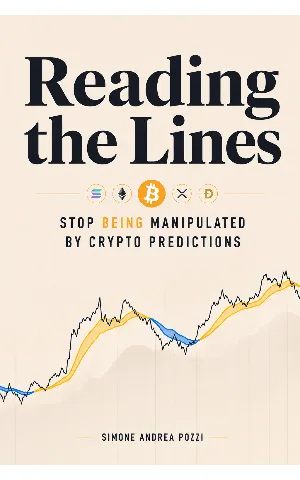
Reading The Lines
Replace noise and prediction with a disciplined framework for reading crypto market trends — using moving averages and a four-state classification system to see charts with structure and clarity.
Available on Amazon Kindle
Related reading